Question: Given the following grammar,
<program> ::= <stmt_list>
<stmt_list> ::= <stmt> | <stmt> <stmt_list>
<stmt> ::= <declaration_stmt> | <assign_stmt>
<declaration_stmt> ::= int <ident_list> ;
<ident_list> ::= <var_id> | <var_id> , <ident_list>
<var_id> ::=  x | y | z
<assign_stmt> ::= <var_id> = <expression> ;
<expression> ::= <expression> + <expression>
               | <expression> * <expression>
               | <constant> | <var_id>
<constant> ::= 0 | 1 | 2 | 3 | 4 | 5 | 6 | 7 | 8 | 9
a) Drive the string "int x, y; x = x + 5 * y;",
using the leftmost derivation to show that it is in the language.
b) Show its parse tree.
c) Is the grammar ambiguous or not?
Answer:
a) The rightmost derivation:
<program> ⇒ <stmt_list>
          ⇒ <stmt> <stmt_list>
          ⇒ <declaration_stmt> <stmt_list>
          ⇒ int <ident_list> ; <stmt_list>
          ⇒ int <var_id> , <ident_list> ; <stmt_list>
          ⇒ int x , <ident_list> ; <stmt_list>
          ⇒ int x , <var_id> ; <stmt_list>
          ⇒ int x , y ; <stmt_list>
          ⇒ int x , y ; <stmt>
          ⇒ int x , y ; <assign_stmt>
          ⇒ int x , y ; <var_id> = <expression> ;
          ⇒ int x , y ; x = <expression> ;
          ⇒ int x , y ; x = <expression + <expression>  ;
          ⇒ int x , y ; x = <var_id> + <expression> ;
          ⇒ int x , y ; x = x + <expression> ;
          ⇒ int x , y ; x = x + <expression> * <expression> ;
          ⇒ int x , y ; x = x + <constant> * <expression> ;
          ⇒ int x , y ; x = x + 5 * <expression>;
          ⇒ int x , y ; x = x + 5 * <var_id>;
          ⇒ int x , y ; x = x + 5 * y; ✓
21 sentential forms.
b) A parse tree
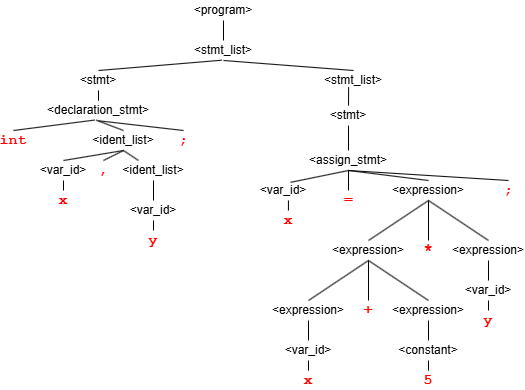
c) It is ambiguous,
becuase instead of <expression> ::= <expression> + <expression> rule,
<expression> ::= <expression> * <expression> could be chosen, leading to a different parse tree.
Question: Disambiguate the following grammar:
<program> ::= <stmt_list>
<stmt_list> ::= <stmt> | <stmt> <stmt_list>
<stmt> ::= <declaration_stmt> | <assign_stmt>
<declaration_stmt> ::= int <ident_list> ;
<ident_list> ::= <var_id> | <var_id> , <ident_list>
<var_id> ::=  x | y | z
<assign_stmt> ::= <var_id> = <expr> ;
<expression> ::= <expr> + <expr>
               | <expr> * <expr>
               | <constant> | <var_id>
<constant> ::= 0 | 1 | 2 | 3 | 4 | 5 | 6 | 7 | 8 | 9
Answer:
<program> ::= <stmt_list>
<stmt_list> ::= <stmt> | <stmt> <stmt_list>
<stmt> ::= <declaration_stmt> | <assign_stmt>
<declaration_stmt> ::= int <ident_list> ;
<ident_list> ::= <var_id> | <var_id> , <ident_list>
<var_id> ::=  x | y | z
<assign_stmt> ::= <var_id> = <expr_0> ;
<expr_0> ::= <expr_0> + <expr_1>
           | <expr_1>
<expr_1> ::= <expr_1> + <expr_2>
           | <expr_2>
<expr_2> ::=  <constant> | <var_id>
<constant> ::= 0 | 1 | 2 | 3 | 4 | 5 | 6 | 7 | 8 | 9